

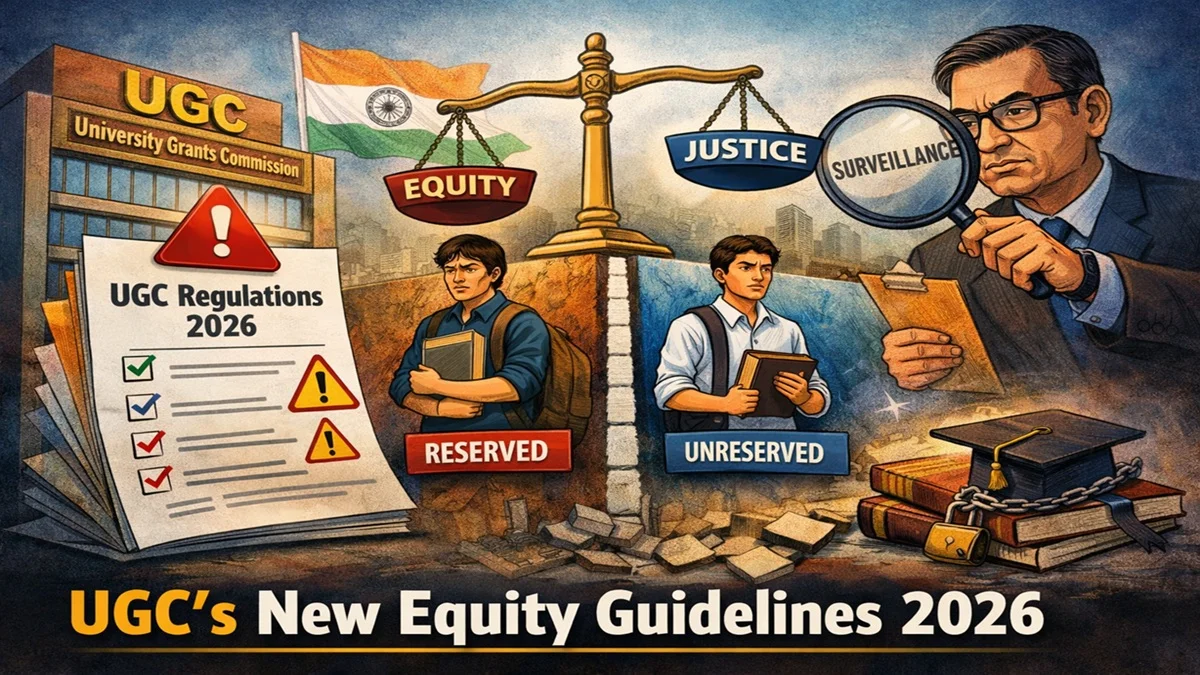
If you’ve been scrolling through your news feed lately, you’ve likely seen a storm brewing in the Indian education sector. What started as an update to the decade-old UGC Equity Rules 2026 has quickly transformed into one of the most heated social and legal battles of the year. For those of us who have spent years tracking policy shifts in India, this isn’t just another administrative update—it’s a fundamental shift in how “fairness” is defined on our campuses.
The UGC 2026 Row is no longer confined to academic boardrooms. It’s in the Supreme Court, it’s on the streets of Lucknow, and it’s at the heart of every faculty lounge discussion. The promise was simple: make campuses safer and more inclusive. But as they say, the devil is in the details, and the details of these new regulations have left a massive section of the student population feeling targeted and unprotected.
Summary: The UGC 2026 Row centers on the newly notified “Promotion of Equity in Higher Education Institutions Regulations, 2026.” Critics argue that the UGC Rule 3c Caste Definition creates a “hierarchy of victimhood” by recognizing caste discrimination only against SC, ST, and OBC members, effectively excluding the general category. Coupled with the removal of the False Complaints Clause UGC 2026, these rules have sparked a Supreme Court UGC 2026 PIL and widespread General Category Protests UGC, particularly in Uttar Pradesh. The controversy highlights a growing debate over Reverse Discrimination in Colleges India, as stakeholders demand a caste-neutral framework that protects all students equally.
The Core of the UGC 2026 Rules Controversy
On January 13, 2026, the University Grants Commission notified a fresh set of guidelines intended to replace the 2012 framework. The stated goal was to align higher education with the National Education Policy (NEP) 2020 by embedding “equity and inclusion” into the DNA of every college.
However, the UGC 2026 Rules Controversy erupted almost immediately. Unlike the previous version, these rules are not mere suggestions—they are enforceable mandates. Institutions that fail to comply face severe penalties, including the withdrawal of grants and derecognition. While accountability is good, the framework used to achieve it has been labeled by many as “ideological overreach” rather than a balanced administrative tool.
The Exclusionary Definition: Understanding UGC Rule 3c
If you want to know why people are angry, you have to look at UGC Rule 3c Caste Definition. This is the heart of the legal challenge. In its attempt to be specific, the UGC has defined “caste-based discrimination” as something that only happens to members of the Scheduled Castes (SC), Scheduled Tribes (ST), and Other Backward Classes (OBC).
- The Unidirectional Bias: The law essentially presumes that discrimination is a one-way street. In a country as diverse as India, we know that social friction can happen in any direction.
- The Victimhood Gap: By specifically naming these groups and excluding others, the regulation suggests that a student from the general category cannot, by definition, be a victim of caste-based harassment.
- Constitutional Concerns: This narrow framing is why the Rollback UGC 2026 Trend took off. Legal experts argue that any law protecting against discrimination must be “caste-neutral” to pass the test of Article 14 (Equality before Law).
From my perspective, this is where the policy loses its way. When you tell a group of people that their grievances don’t legally exist, you don’t create equity—you create resentment.
The Disappearing Safeguard: False Complaints Clause UGC 2026
Perhaps the most alarming change from the draft stage to the final notification was the removal of the False Complaints Clause UGC 2026.
In the 2025 draft, there was a clear provision: if someone filed a malicious or false complaint, they would face penalties. This is a standard “checks and balances” feature in almost any modern legal framework. Yet, the final 2026 rules dropped it entirely.
The result? A “presumption of guilt” that has left faculty and students terrified.
- Process as Punishment: In a university, even a temporary allegation can destroy a career or a student’s mental health long before an inquiry is finished.
- Unchecked Authority: The new Equity Committees have massive powers to recommend suspension or expulsion, but with no deterrent for false reporting, the system is ripe for personal or political vendettas.
Supreme Court UGC 2026 PIL: A Legal Face-off
The battle is now in the hands of the judiciary. The Supreme Court UGC 2026 PIL, filed by researchers and advocates like Vineet Jindal, argues that these rules are ultra vires—they go beyond the powers granted to the UGC.
The petitioners are making a very human argument: Discrimination is wrong, period. Whether it’s an SC student facing bias from a professor or a General Category student facing harassment from a group in a hostel, the protection should be the same. The Supreme Court is being asked to “read down” these rules and ensure that the New UGC Rules for General Category are inclusive rather than divisive.
Campus Unrest: General Category Protests UGC
The digital outcry has turned into physical demonstrations. Across major hubs, we are seeing General Category Protests UGC that remind us how deeply these policies affect everyday life.
Student Protest Lucknow UGC Row
Uttar Pradesh has become the “Ground Zero” for this movement. At Lucknow University, the atmosphere is electric. Students have dubbed the regulations a “Black Law,” and the movement is gaining steam across the state—from Varanasi to Aligarh.
- UGC Rules 2026 impact on UP Universities: The fallout has been unprecedented. We’ve seen the resignation of Bareilly City Magistrate Alankar Agnihotri, who chose to step down rather than enforce what he called a socially divisive law.
- Political Ripple Effects: Even within the ruling party, local leaders in Lucknow have resigned, citing concerns that their own base feels alienated and unsafe under these new rules.
I recently spoke with a student leader in Lucknow who put it perfectly: “We aren’t against social justice for our brothers in the SC/ST communities. We are against a law that treats us as criminals by default.”
The “Reverse Discrimination” Debate
We have to be honest about the phrase Reverse Discrimination in Colleges India. For a long time, this was a term used in hushed tones or fringe debates. Today, it is mainstream.
The concern is that the UGC Equity Rules 2026 create a “special class” of citizens within the university. When a grievance cell is mandated to have representation from every group except the general category, it’s hard to convince people that the process will be impartial. This perceived imbalance is fueling a sense of betrayal among those who believe merit and fairness should be the only benchmarks in education.
What Happens Next?
The Ministry of Education has hinted that a “clarification” might be coming to address these “misunderstandings.” But a clarification is rarely enough when the statutory text itself is flawed.
For India to maintain its status as a global education hub, our campuses must be places of unity, not laboratories for social division. Whether the government decides to listen to the Rollback UGC 2026 Trend or waits for the Supreme Court to intervene, one thing is clear: the current path is unsustainable.
Read more: Chanakya’s Political Wisdom Applied to Modern-Day Governance
A Call for Common Sense
True equity isn’t about shifting the target of exclusion; it’s about removing exclusion altogether. The UGC 2026 Row is a wake-up call for policy makers. Laws intended to heal historical wounds should not create new ones.
What do you think?
Should the UGC redefine these rules to be caste-neutral, or is the current specific focus necessary for social justice?
Share your thoughts in the comments below and let’s keep the conversation going. If you found this deep dive helpful, please share it with your network to raise awareness about this critical issue.
What exactly is the UGC Rule 3c Caste Definition and why is it controversial?
The UGC Rule 3c Caste Definition is the primary flashpoint of the UGC 2026 Rules Controversy. It defines “caste-based discrimination” strictly as unfair treatment against members of Scheduled Castes (SC), Scheduled Tribes (ST), and Other Backward Classes (OBC).
The Controversy: By specifically naming only these categories, the rule excludes the general category from the definition of caste discrimination. This “non-inclusionary” approach has led to claims that the law creates a hierarchy of protection, where students from unreserved backgrounds are denied the same institutional safeguards even if they face genuine harassment or bias.
Can General Category students still file complaints under the new UGC Equity Rules 2026?
Technically, yes, but there is a major catch. While the broader definition of “discrimination” in the UGC Equity Rules 2026 covers religion, gender, and disability for everyone, the specific and more severe “caste-based” protections are reserved for SC/ST/OBC groups under Rule 3(c).
The Concern: General category students feel marginalized because the mandatory Equity Committees are not required to have representatives from the unreserved category. This has led to the General Category Protests UGC movement, as students fear that their grievances will be handled by a one-sided committee without fair representation.
What are the consequences of the missing False Complaints Clause UGC 2026?
In earlier drafts, the UGC included a provision to penalize anyone who filed a “false or malicious” complaint. However, the final version notified in January 2026 removed this safeguard.
The Impact: The absence of a False Complaints Clause UGC 2026 means there is no legal deterrent against misuse of the rules. For faculty and students—particularly those from the unreserved category—this creates an environment where “the process becomes the punishment.” A single unsubstantiated allegation can trigger a 24-hour emergency probe, leading to potential suspension or career damage before the truth is even established.
Why has the Supreme Court UGC 2026 PIL become so significant?
The Supreme Court UGC 2026 PIL is the last line of defense for those seeking a “caste-neutral” framework. Petitioners argue that by protecting only specific castes, the UGC is violating Article 14 (Right to Equality) and Article 15 (Prohibition of Discrimination) of the Indian Constitution.
What’s at Stake: If the Supreme Court agrees with the petitioners, it could force the UGC to redefine discrimination to protect all students regardless of their caste identity. This legal face-off is the main reason why the Rollback UGC 2026 Trend continues to dominate national discourse.
How do the new rules specifically impact universities in Uttar Pradesh?
The UGC Rules 2026 impact on UP Universities has been particularly intense due to the high political and social sensitivity in the region. The Student Protest Lucknow UGC Row at Lucknow University has seen thousands of students demanding a complete rollback.
The Fallout: UP has witnessed unprecedented dissent, including the resignation of high-ranking bureaucrats and political office-bearers who have labeled the regulations as a “Black Law.” Many universities in the state are struggling to balance the mandatory 24/7 “Equity Squads” and “Helplines” with a student body that feels the rules are being used to institutionalize Reverse Discrimination in Colleges India.